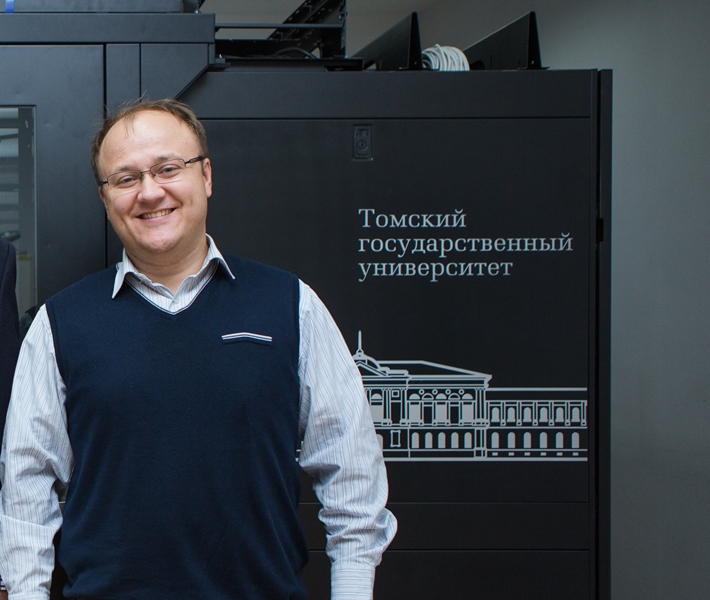
The computing cluster SKIF Cyberia is one of the most powerful supercomputers in Russia, used for scientific research. Among the tasks that are currently being addressed with its help are designing rocket and space technology and safe mining equipment; the creation of new types of rocket fuel and superhard coatings using nanotechnology; integrated environmental monitoring of the atmosphere and hydrosphere; control of the spread of fires and epidemics; recovery of contaminated soils; and others. In the near future, the performance of the supercomputer will be significantly expanded.
- The capacity of SKIF Cyberia will increase by half again - from 63.7 to 100 teraflops, and then the supercomputer can perform 100 trillion operations per second, - said Sergei Orlov, the director of the Interregional Supercomputing Centre of TSU. - The number of processing cores will increase from 5.5 to 6.5 million, and RAM will reach 18 Terabytes.
This will provide additional opportunities to researchers who use supercomputers in research projects. One of the most active users of SKIF Cyberia at the TSU laboratory are the Nanostructured Surfaces and Coatings Laboratory and the Laboratory of Quantum Mechanics of Molecules and Radiation Processes.
The computing cluster is used also by scientists of other units of Tomsk State University. For example, the basic design center NII PMM TSU has developed software for testing electronic devices of on-board equipment of spacecraft under vibration and shock loads. Most of the calculations were carried out on the supercomputer SKIF Cyberia.
The Department of Celestial Mechanics and Astrometry of NII PMM TSU leverages the computing cluster in studies of the dynamics of asteroids approaching Earth, and in the study of the dynamics of space debris. Using the supercomputer, scientists calculate the long-term evolution of large sets of near-Earth space objects.
The computing cluster is open to external users. For example, the institutions of the SB RAS willingly use the opportunities of the Centre. The services of the computing cluster are also actively used by the firms engaged in three-dimensional graphics, and many other companies.