News on the updates from the TSU Laboratory for Medical Alloys and Shape Memory Implants appears on the website of our University rather often. The researchers of the Laboratory continue working on what Professor Victor E. Gunter started over 30 years ago.
It is interesting that practical achievements of the TSU researchers sometimes go ahead of their scientific justification and description. They are tested and registered, they start improving quality of life of thousands of people and only after that, they become subjects for scientific reflection. Its purpose in this case is to identify patterns and to explain why something worked out.
This is exactly what happened with a new method for the production of porous titanium nickelide for implants. During such a production non-metallic crystals are formed on the surface of the material. Thin but dense layers with integrated crystals based on sodium and calcium phosphate increase biocompatibility, shorten the implant survival time and protect implants against oxidation. Sodium and calcium phosphate are also present in natural human bone tissues. This “tricks” the body’s immune system. Surrounding cells take the implant material “for their own”, do not tear it away and grow fast into the artificial surface.
The porous titanium nickelide alloy itself has such an important property as shape memory. Without it, any external impact on the artificial bone, starting with an awkward movement during rehabilitation and ending with all kinds of injuries, can lead to the formation of micro cracks. Even damage to the implant that is invisible to the eye leads to the fact that atoms come to its surface, they oxidize and transfer toxic oxidation products to the tissues around, which then accumulate in the organs. But what happens with titanium nickelide when it is exposed to external factors? The stress that appears in the material causes a phase transition: one crystalline structure transfers to another. Such a transformation may be illustrated as the melting of ice when temperature increases. Relaxation occurs in the structure of titanium nickelide: the material becomes softer and does not break. And when stress is removed, it takes back its original form. This property is called biomechanical compatibility, which made it possible to replace not only large bones (ribs, femurs, etc.), but also very small and thin ones, which are so necessary for replacement in maxillofacial transplantology.
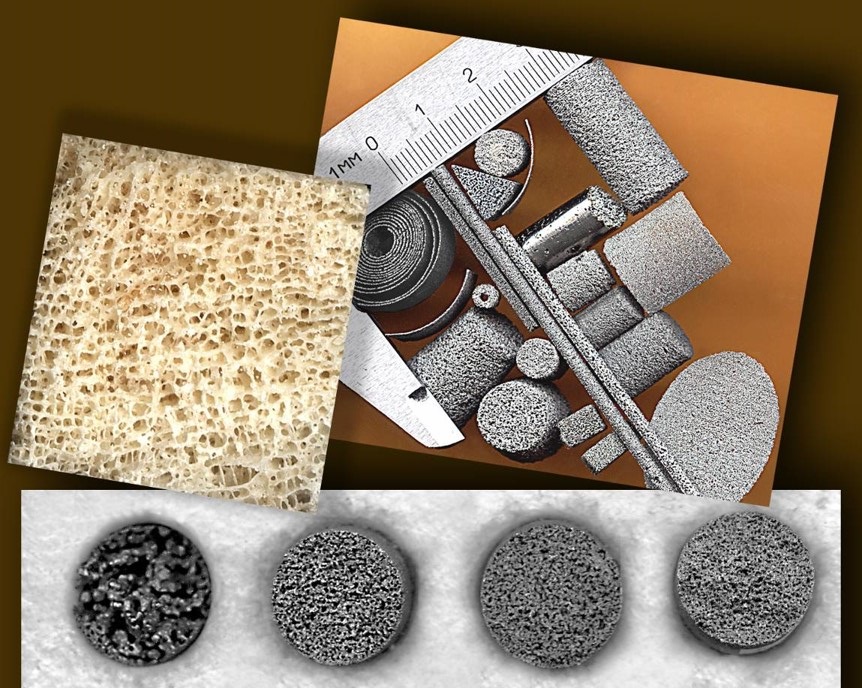 It is hard to imagine how much such transplants would cost in the USA or Europe. In Russia this products are literally affordable by anyone. Their production is organized in the Medical Engineering Center on the basis of the TSU Laboratory for Medical Alloys and Shape Memory Implants. Despite the fact that each part of any product is hand-made, the price is still quite affordable. For example, the price for an endo-prosthetic rib is about 11,000 rubles. Although this is a complex element consisting of several plates - monolithic and porous.
Unfortunately, many clinics work only with manufacturers that propose implants made of traditional materials (titanium, tantalum, ceramics, stainless steel, ets.). Their hands are tied by long-term contracts. Nevertheless, the Center finds more and more customers. These are doctors who are ready to try new things. Of course, their readiness is not based on a thirst for adventure, but on the positive results of many years of clinical trials of implants. The success of various tests is confirmed by numerous certificates and other necessary documents.
The Editorial Board of the blog appreciates the help from Ekaterina Marchenko, Head of the TSU Laboratory for Medical Alloys and Shape Memory Implants